
Background Information
Kidepo ranks among Africa’s finest wildernesses. From Apoka, in the heart of the national park, a savanna landscape extends in all directions, far beyond the gazetted area of 1442km2, towards horizons outlined by distant mountain ranges.
The park has a semi-arid climate with just one rainy season per year (April-September) and rainfall is light. The valley of the Narus river in the south of the park receives some 890mm of rain/year while just 635mm of rain/year falls in the Kidepo valley to the north. Both rivers are seasonal, and dwindle and disappear in the dry season. During these months, the only permanent water in the park is found in wetlands and remnant pools along the southern Narus valley near Apoka and as a result, wildlife is concentrated in this area. This consideration, combined with the valley’s open, savanna habitat, makes the park a prime game viewing location on a Uganda safari. Indeed it is possible to sight a good variety of wildlife simply by scanning the valley with binoculars from the comfort of the Apoka lodge.
What to see and do
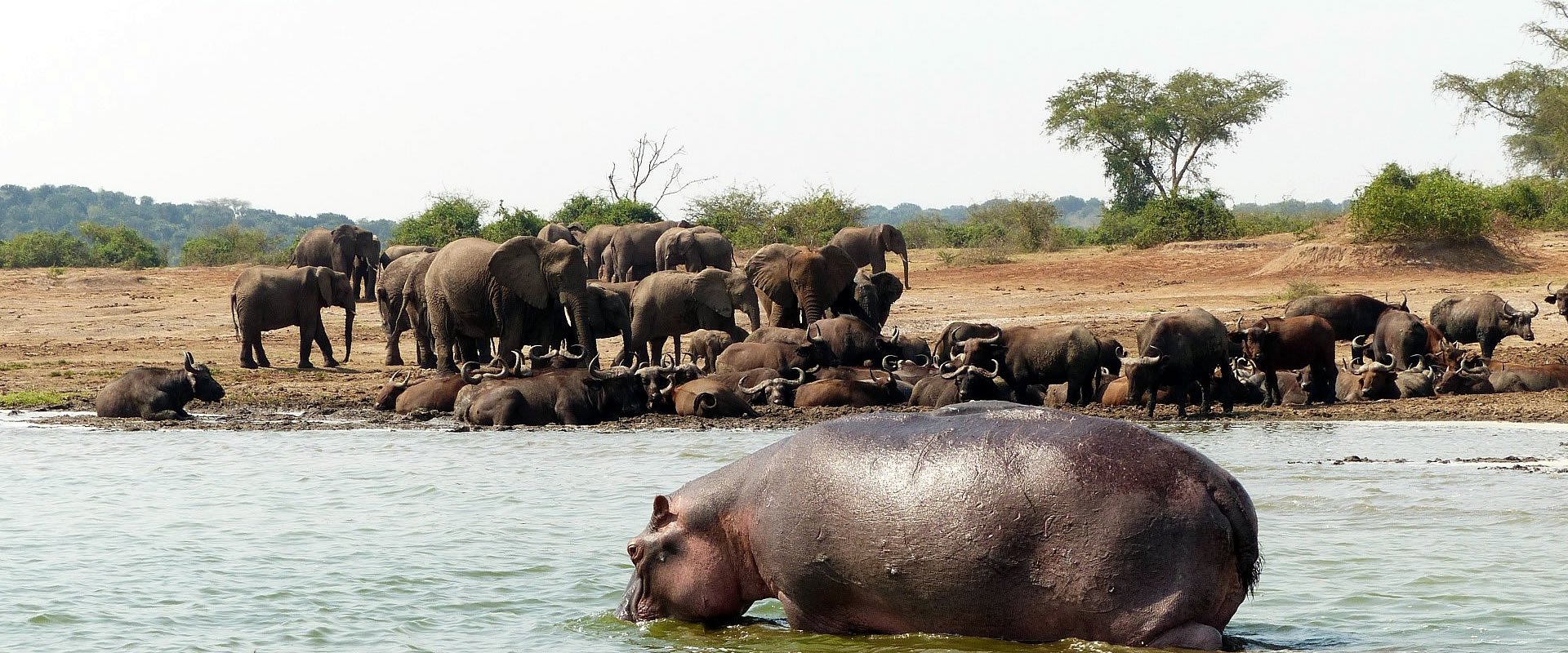
A park ranger will help you spot the lions that may be sitting on the valley’s various rocks. Other wildlife includes elephants, leopard, bush duiker, jackal, bushbuck, bush pig, ostrich, buffalo and much more, in the wild Narus Valley.
Apoka Rest Camp is a great spot to begin your Kidepo birding experience. Birding can also be done on the fringes of the Narus and Namamukweny Valleys.
Hike to the Lomej Mountains, take leisurely walks through the Narus Vally, meet members of the endangered IK tribe and wander the splendid Kidepo River Valley between banks of borassus palm forest.
Lorokul Cultural Group: The cattle-herding Karamojong occupy the north-east of Uganda, in an area covering one tenth of the country. Discover the unique culture of this remote tribe with the Lorukul Cultural Group, located just outside Kidepo Valley National Park.
Where to find Kidepo Valley National Park
Getting There
The park can be reached by both road and air. Driving is more rewarding, as much of Karamoja, like Kidepo itself, is a vast and unspoiled wilderness. However, road conditions are sometimes difficult and 4WD vehicles are usually essential for a safari in Uganda.
There are four possible routes by road: routes via Mbale pass to the east of Lake Kyoga to reach northern Uganda; routes via Karuma pass to the west.
- Kampala-Mbale-Soroti-Kidepo (792km)
- Kampala-Mbale-Sironko-Kotido-Kaboong-Kidepo (740km)
- Kampala-Karuma-Lira-Kotido-Kidepo (705km)
- Kampala-Karuma-Gulu-Kitgum-Kidepo (571km)
Top Select Destinations in East Africa
Where to go, What to do while on Safari


Global Presence and Sales Support
Nairobi
Mirage Plaza, 3rd Floor
P.O. Box 26551-00100, Nairobi.
+254 721 281538
info@alltimesafaris.com
www.alltimesafaris.com
ASEAN Sales Office
Represented by MGW DMC Network
BG-01-01, Megan Ambassy
225, Jalan Ampang, 50450 Kuala Lumpur, Malaysia
MGW DMC Network is a division of MagaBorneo Tourism & Leisure Sdn Bhd
ASEAN Representative
Khirul Zainie,
Director of Marketing
ASEAN Countries.
khirul@alltimesafaris.com
khirul@megaborneotourism.com
khirul@mgwdmc.com
WhatsApp: +60 11 25487800
Facebook | View our Packages