
Background Information
Lake Mburo National Park is a compact gem, located conveniently close to the highway that connects Kampala to the parks of western Uganda. It is the smallest of Uganda’s savannah national parks and underlain by ancient Precambrian metamorphic rocks which date back more than 500 million years. It is home to 350 bird species as well as zebra, impala, eland, buffalo, oribi, Defassa waterbuck, leopard, hippo, hyena, topi and reedbuck. Together with 13 other lakes in the area, Lake Mburo forms part of a 50km-long wetland system linked by a swamp. Five of these lakes lie within the park’s borders. Once covered by open savanna, Lake Mburo National Park now contains much woodland as there are no elephants to tame the vegetation. In the western part of the park, the savanna is interspersed with rocky ridges and forested gorges while patches of papyrus swamp and narrow bands of lush riparian woodland line many lakes.
What to see and do
Wildlife: The park's varied habitats support 68 mammal species. Rarities include impala, which, in Uganda, only lives in Lake Mburo, and Burchell’s zebra and eland which are found only here and in Kidepo.
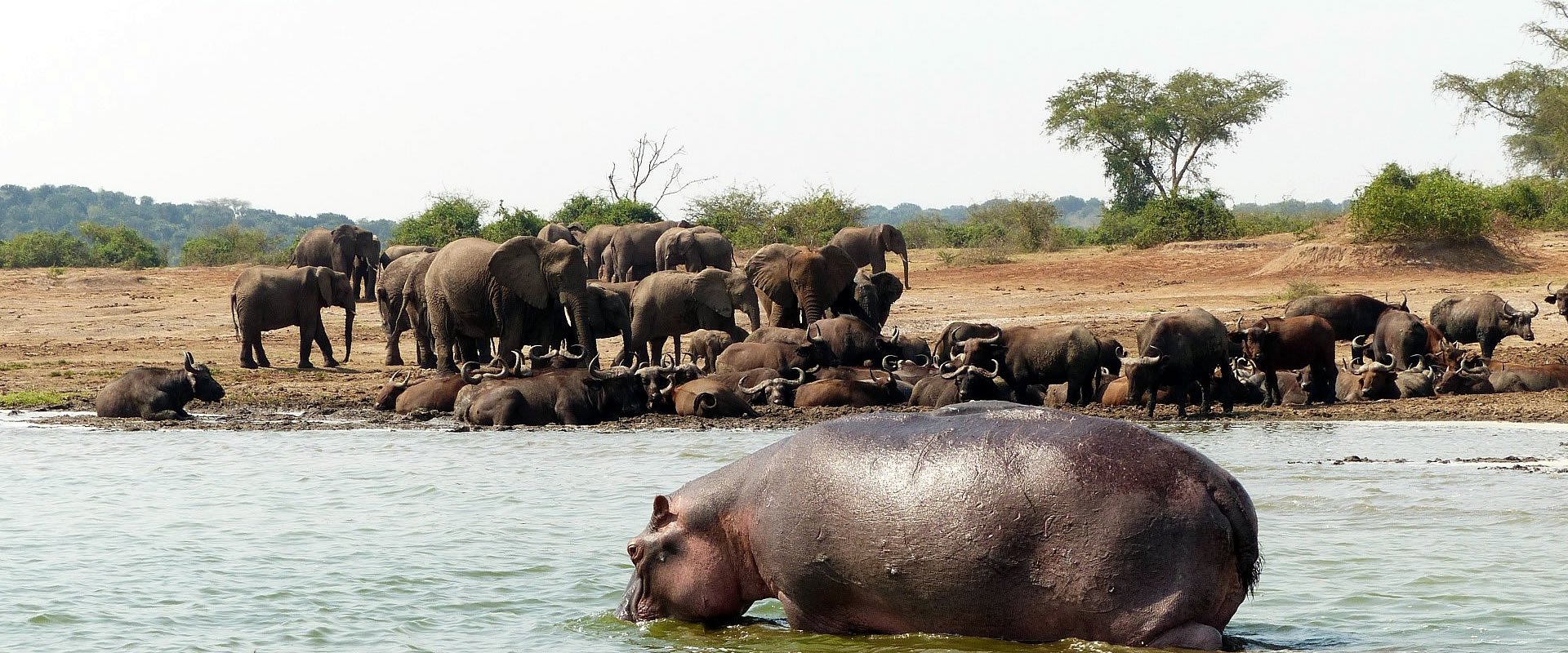
Other species include warthog, buffalo, oribi, Defassa waterbuck and reedbuck. Leopard and hyena are also present while crocodile and over 300 hippos are found in the lake. Previously extinct in the park, lions have recently been sighted again.
Birdlife: Around 350 bird species have been recorded to date. These include the Red-faced Barbet, only seen in Lake Mburo, the endemic African Finfoot and the rare Shoebill. Other key species are the Papyrus Yellow Warbler, Saddle-billed Stork, Brown-chested Lapwing, African-wattled Lapwing, Carruther’s Cisticola, Tabora (Long-tailed) Cisticola, African Scops Owl, Abyssinian Ground Hornbill and White-winged Warbler.
Acacia woodland bird species are especially well represented, while forest species may be found in Rubanga forest. These include Blue-breasted Kingfisher, Hairy-breasted Barbet and Yellow-rumped Tinkerbird, among others.
Where to find Lake Mburo National Park
Climate
Two Wet seasons give Lake Mburo a good soaking from March to May and September to November. The rainfall tends to peak in April and lessen in the second half of the year. The drier periods of the year (June to August and December to February) barely qualify as Dry seasons – they’re just less wet.
Top Select Destinations in East Africa
Where to go, What to do while on Safari


Global Presence and Sales Support
Nairobi
Mirage Plaza, 3rd Floor
P.O. Box 26551-00100, Nairobi.
+254 721 281538
info@alltimesafaris.com
www.alltimesafaris.com
ASEAN Sales Office
Represented by MGW DMC Network
BG-01-01, Megan Ambassy
225, Jalan Ampang, 50450 Kuala Lumpur, Malaysia
MGW DMC Network is a division of MagaBorneo Tourism & Leisure Sdn Bhd
ASEAN Representative
Khirul Zainie,
Director of Marketing
ASEAN Countries.
khirul@alltimesafaris.com
khirul@megaborneotourism.com
khirul@mgwdmc.com
WhatsApp: +60 11 25487800
Facebook | View our Packages