
Background Information
The meandering Victoria Nile and the dramatic Murchison Falls make this National Park, the biggest in the country, a stunning habitat for wildlife. Murchison Falls was discovered by Samuel Baker in 1864. The 50 meter wide Nile is forced through a narrow cleft in the rocks, dropping down with a thundering roar and a beautiful rainbow. The launch trip to the bottom of the Falls is unforgettable, both to experience this mighty river and to see the huge crocodiles, hippos and birds that bask on its banks.
The terrain is dominated by rolling savannah and tall grassland. Buffalo, Rothschild’s giraffe, Uganda kob, hartebeest and waterbuck are commonly seen. You may also spot oribi, bushbuck, Bohor reedbuck, sitatunga, bush duiker, warthog and bushpig. Among the large carnivores, lion, leopard and spotted hyena are seen. The park boasts over 450 bird species including the Goliath heron, Egyptian goose, pelican, bee-eater, kingfisher, hornbill, cormorant, and the rare shoebill stork
What to see and do
The park is bisected by the very scenic Victoria Nile. A boat trip takes you to the base of the Murchison Falls where you can see the Nile squeezing through a narrow gorge before dropping down into the ‘Devil's Cauldron’. North of the river is a savannah habitat dominated by grassland dotted with borassus palms. South of the river, the habitat changes to woodland with forest patches.
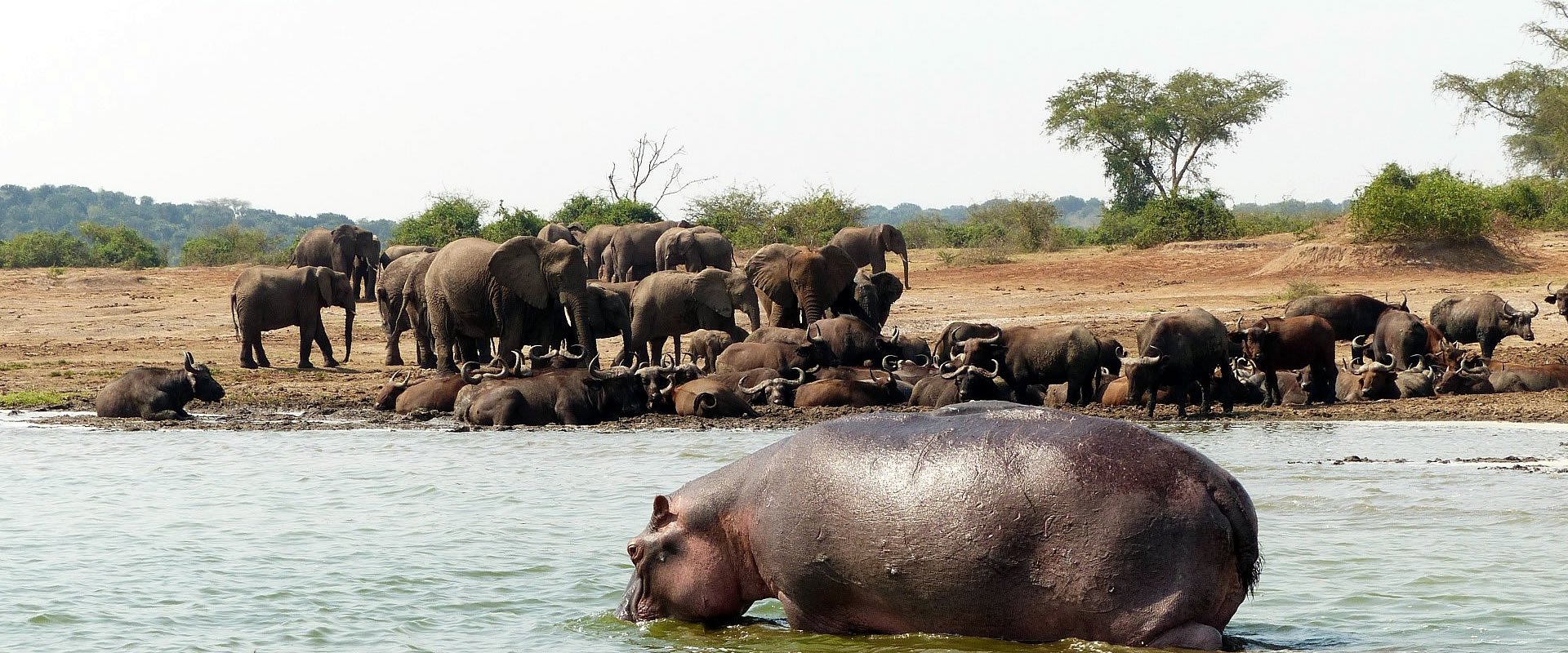
Four of the Big Five can be seen, but rhino are absent. Huge herds of elephant and buffalo are common, and lion are easily spotted. Antelope include Jackson's hartebeest, waterbuck and Uganda kob. Large herds of giraffe are a specialty. Similar is the case of the localized patas monkey. Chimpanzee and several other primates can be tracked in Budongo forest in the south of the greater Murchison Falls Conservation Area.
Where to find Murchison Falls National Park
Climate
The climate in Murchison Falls is tropical and hot. Being close to the equator, temperatures are quite uniform throughout the year. Daytime temperatures of around 31°C/88°F are common, with it cooling down at night to around 18°C/64°F. The altitude ranges from 500-1,292m (1,650-4,240ft), so climatic variations occur within the park as temperatures drop by about 6.5°C for every 1,000m you climb (or 3.5°F per 1,000ft). The Wet season runs from March to November, with a period of less rain from June to July. There is little rain during the Dry season, which occurs from December to February. It doesn't rain that much in the Wet season either, but heavy storms can be expected.
Top Select Destinations in East Africa
Where to go, What to do while on Safari


Global Presence and Sales Support
Nairobi
Mirage Plaza, 3rd Floor
P.O. Box 26551-00100, Nairobi.
+254 721 281538
info@alltimesafaris.com
www.alltimesafaris.com
ASEAN Sales Office
Represented by MGW DMC Network
BG-01-01, Megan Ambassy
225, Jalan Ampang, 50450 Kuala Lumpur, Malaysia
MGW DMC Network is a division of MagaBorneo Tourism & Leisure Sdn Bhd
ASEAN Representative
Khirul Zainie,
Director of Marketing
ASEAN Countries.
khirul@alltimesafaris.com
khirul@megaborneotourism.com
khirul@mgwdmc.com
WhatsApp: +60 11 25487800
Facebook | View our Packages